Etiketter

Summa sidvisningar

Leta i den här bloggen

tisdag 28 april 2026

Glukoosi ja silmä


Glucose exposure suppresses brain aromatase and impairs retinal regeneration in zebrafish.

Ulhaq ZS, Takamune K, Kishida M.Exp Eye Res. 2026 Mar;264:110853. doi: 10.1016/j.exer.2026.110853. Epub 2026 Jan 7.PMID: 41512949


https://pubmed.ncbi.nlm.nih.gov/41512949/

måndag 13 april 2026

Miksi Musiinien asian asetan GLUKOOSI-blogiin?

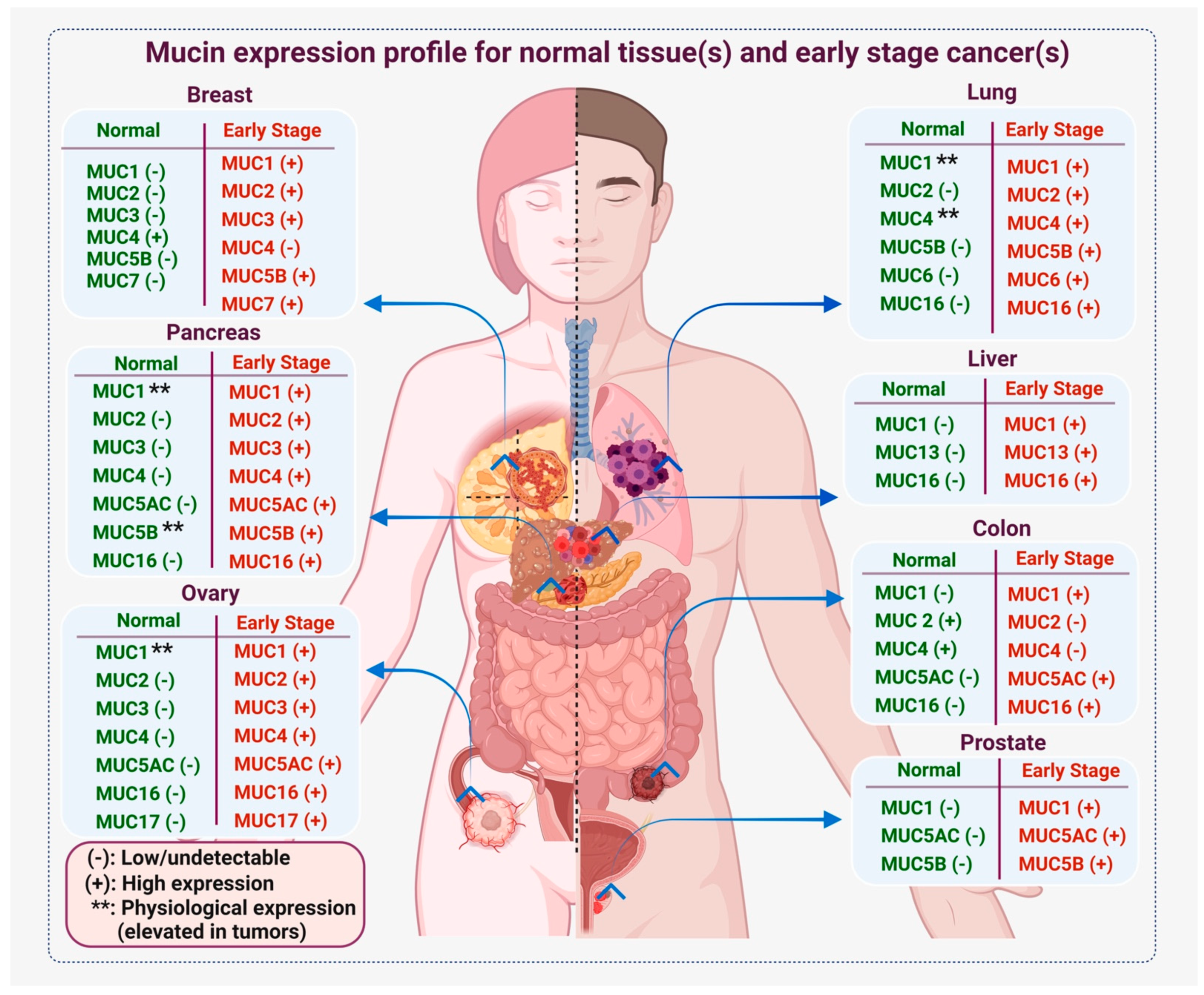
 Hiilihydraattiaineenvaihdunta  on  avaintekijä näissä Musiinien  normaaliudessa tai  suistumisessa epäsäännlliseen säätelyyn.  Niiten rakenne muistutta lähinnä pulloharjaa ja ne kaikki pulloharjannharjakset  vastaavat musiinirakenteessa glykosyloituja sivuketjúja. Normaali glykosylatio on välttmåtön musiinin normaalifunktiolle. O-glykosyloituneet   haarat,   kasvavat geneettisesti säätyneeseen  ulottuvuuteen päärungosta ja siitä muodostuu se suojaava   valli, jolla musiinit   puolustavat eri onteloiden, pintuja, kuten suoliston pintoja, keuhkoputkiston  eri hqrohen  pintoja,  haiman ja maksan tiehyitä, rintarauhasen, prostatan tiehyeitä , silmän pintoja, sidekalvoa,  sarveiskalvoa,  suuonteloa, syljen musiineissa.  Artikkelin kuvassa  on valittu   ihmiskuntaa vaiivaavista  syövistä suurinta  kuolleisuutta  aiheuttavat   miehillä ja naisilla, kuten  keuhkosyöpä,  rintasyöpä,  ovariaalisyöpä, prostatasyöpä, syövistä  haimasyöpä,  paksunsuolen syöpä, maksasyöpä.  Nämä kuusi  kudosaluetta   katsotaan sekä terveiltettäsypäåptilailta  Musiinikirjon suhteen. Kun kirjoja tilastollisessti tarkistetaan, löytyy  piirteitä, joiden perusteella Musiinien kirjo  osoittaa  viitteitä elinten  terveydestä tai   alkavista  pahanlaatuisuuksistas. Muutokset ovat kudosspesifisiä ,  Mahdollisia biomerkitsijöiksi sopivia  kombinaatioita  löytyy ja yhdistettynä jo käytössä oleviin  merkitsijöihin saadaan  hyötynä mm aikalisää, koska musiinit muuttuvat  varhemmin kuin  mitä perinnäisin keinoin voidaan havaita alkavia pahanlaatuisuuksia. Tämä on uutta  tietoa. Jotkut musiinit jo ovat  käytössä näistä. 


Toinen asia on katsahtaa  gekijöihin, mitkä suistavat normaalit musiinit   edistämään  tuumoreita. Sen tiedon lisääntyessä pystytään välttämään niien  aineenvaihdunnan turmeltumist. Yksi tunnettu tekijänon tupakanpoltto, mikä vaivoin on saatu  esim Rutosista lopetettua työpäikoilla ja monissa yleisissä tiloissa, mikäaltistaa muuten terveitä ihmisiä musiinien  muuttumiselle, vaikka he eivät itse polttaisi savukettakaan. 

Alla olevassa artikkelissa on musiinien pulloharjamuodosga  valaiseva kuva. 

https://pub.mdpi-res.com/cancers/cancers-15-01640/article_deploy/html/images/cancers-15-01640-g001.png?1678421068


Toinen tekijä mihin voidaan tehokkaammin vaikuttaa, on ravinto. Sen  liiallinen glykeemisyys on suuri haitta  proteiinien normaalissa glykosylaatiossa,  Lisäksi eräät  musiinit edistävät  GLUT1 ja GLUT-2  glykooin liikkumista.  Glukoosi itse   on   fruktoosin tai DHA metaboliitin suhteen  vähiten vahingollinen.  Kuten tiedetään diabeteksessa  kertyy fruktoosia ja sorbitolitietä  sekä DHA jää  saamatta fosforylaatonsa jotta pääsisi eteenpäin   glykolyysissä ja kohti energiatietä, ( haitta suhteet niillä 1: 20: 20 000.  Lusäksi  sokeriaineenvaihdunnan  energialähde UTP /UDP  muuttumisineen  entsymaattisissa glykosylaatioissa  on  usein kohdin  paikantamassa   vikakohtia metaboliseen karttan Tässä taas  kaitsijaproteiinin C1GALT1C1 chaperone  mutaatiot   ovat  kriittisiä niiden Tn ja Sialyl-2,3 T rakenteiden  takia.  Jos  glykosyloitunut sivuketju ei pääse kasvamaan   musiiniproteiinin runko jää paljaaksi.    Random glykaatio   muitten  haitallisten  sokerilaatujen välityksellä  on tekijä, johon voi vaikuttaa  veren sokerin  normalisoimisella ja  ravinnon pitämisellä  matalaglygeemisenä. Tässä  länsimaat  eivät ole onnistuneet.  Dieeti muutetaan  vasta kun haima on jo  tuhotumaan päin  ja betasolut vähenemässä. Vaikka  verensokeri palautuisi   kaikenlaisen karamellien ja prosessoitujen ruokien jälkeen  normaalikäyrn  alueelle eikä henkilöä sanottaisi  diabeettiseksi,   kaikenlaiset  mitä ihmeellisimmöt    molekyylit siltä ravinnon suunnalta  haittaavat musiinien  normaalia  posttranslationaalista   varustautumista. ESIM. GENECARDS antaa  MUC1 musiinista  kartan   eri musiiniydinrakenteiden syntetisoitumisista  CORE 1,  CORE. Kuvasta näkyy se  energialähde , mitä sokeriaineenvaihdunnassa   käytetään musiinien muodostuksessa ( CTP, UTP johdannaisten alue) 

MUSIINI glykoproteiinien kirjosta ollaan etsimässä uusiasyövän varhaisasteen ja prognoosin biomerkitsijöitä. Katso artikkelin Kuva 1. Ihmisen musiineista MUC normaalisti ja syövässä-

 Lähde:MUCIN as a potential biomarkers for early detection of cancers. doi:10.3390/cancers15061640
Mucin expression profile in human malignances. Mucin highly deregulatedi n major human cancers.

Mucins as Potential Biomarkers for Early Detection of Cancer


Review

Mucins as Potential Biomarkers for Early Detection of Cancer

by  1,†, 1,†, 1, 1, 1, 2,3, 1,2, 1,2,* and 1,2,*
1
Department of Biochemistry and Molecular Biology, University of Nebraska Medical Center, Omaha, NE 68198, USA
2
Fred & Pamela Buffett Cancer Center, Eppley Institute for Research in Cancer and Allied Diseases, University of Nebraska Medical Center, Omaha, NE 68198, USA
3
Division of Oncology-Hematology, Department of Internal Medicine, VA Nebraska Western Iowa Health Care System, University of Nebraska Medical Center, Omaha, NE 68105, USA
*
Authors to whom correspondence should be addressed.
These authors contributed equally to this work.
Cancers 202315(6), 1640; https://doi.org/10.3390/cancers15061640
Submission received: 1 February 2023 / Revised: 25 February 2023 / Accepted: 27 February 2023 / Published: 7 March 2023
(This article belongs to the Collection Cancer Biomarkers)

Simple Summary

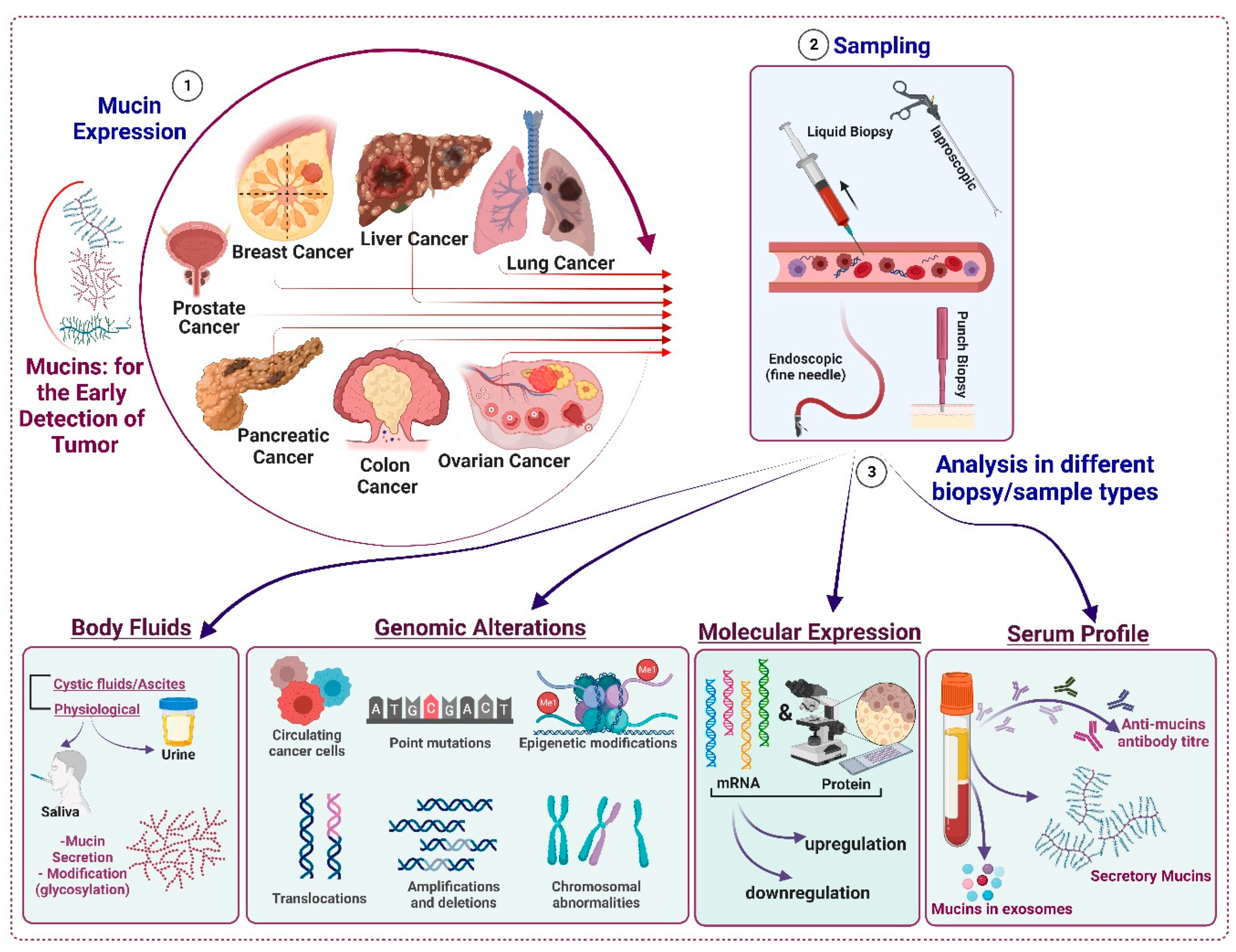
Early cancer detection is a challenge in treating cancer patients. Remarkably, carcinomas of the breast, lung, liver, pancreas, ovary, and colon contribute to more than 50% of total incidences and mortality annually, which could be reduced by early detection. As mucins are highly upregulated during the early progression of these cancers, several studies have explored mucins as potential biomarkers. Due to their membrane-bound and secretory nature, mucins have been detected in tumor biopsies and liquid biopsies of cancer patients, including blood and urine samples. We compiled here previous studies advocating for the use of mucins as potential biomarkers for the early detection of cancer and discuss the opportunities and challenges related to the use of mucin biomarkers in combination with other biomarkers and detection modalities.


Figure 1 Mucin expression profile in human malignancies. Mucins are highly deregulated proteins in major human cancers. The right panel in the figure shows changes in the mucin profile in lung cancer, liver cancer, colon cancer, and prostate cancer, whereas the left panel shows mucin deregulation in breast, pancreas, and ovary cancers. A comparison of mucin profile of the normal and early malignancy is shown to emphasize their diagnostic potential in different malignancies. ** represents mucin expression under physiological conditions and the corresponding (+) sign represents further upregulation in cancer. The (-) sign shows non-detectable or lower expression under normal conditions and the (+) sign indicates the measurable increased/high expression of mucins. Red: early-stage expression profile; Green: mucin expression under normal conditions. The Illustrations in the figure were created with the help of BioRender tool.

söndag 12 april 2026

Uusinta Tn antigeenista ja syövästä. Fokus Kaitsijaproteiiniin COSM ja aktiiviin T-syntaasiin, entsymaattiseen O-glykosylaatioon.


GALNT1 emerges as a potential therapeutic target in breast cancer.
Li J, Zhong P, Li X, Huang R, Zhan Z, Li J, Mao M.J Cancer Res Clin Oncol. 2026 Mar 25;152(3):74. doi: 10.1007/s00432-026-06448-2.PMID: 41880012 Free PMC article.
RESULTS: GALNT1 was significantly upregulated in primary breast cancer as well as multiple other malignancies. In vitro experiments demonstrated that GALNT1 promoted breast cancer cell proliferation, migration, and O-glycosylation. Immunofluorescence staining reveal …
 
Transforming Growth Factor-beta Drives Epithelial Mesenchymal Transition and Reduces Synthesis of Unelaborated O-GalNAc Glycans in Breast Cancer Cells.
Cull J, Pink RC, Samuel P, Brooks SA.J Histochem Cytochem. 2026 Mar-Apr;74(2):193-214. doi: 10.1369/00221554261416994. Epub 2026 Feb 28.PMID: 41764140 Free PMC article.
The effect of TGF-beta1 on synthesis of unelaborated Tn antigen was explored using Helix pomatia agglutinin (HPA) labelling. TGF-beta1 treatment induced morphological changes, resulting in an elongated, mesenchymal-like phenotype, and a reduction of epithelial marke …
 
Deletion of Core 1 β3GalT-specific molecular chaperone (Cosmc) in murine intestinal epithelia leads to major alterations in glycocalyx and tumorigenesis.
Ju T, Wang Y, Nishio H, Kudelka MR, Sun X, Wang J, Zeng J, Song L, Akkas G, Adsay V, Parkos CA, Cummings RD.J Biol Chem. 2026 Feb 25;302(4):111319. doi: 10.1016/j.jbc.2026.111319. Online ahead of print.PMID: 41759737 Free PMC article.
Expression of such glycans is under control of Cosmc (C1GalT1C1) that encodes a key ER molecular chaperone required for formation of active T-synthase, a Golgi enzyme that modifies the Tn antigen (GalNAcalpha1-Ser/Thr/Tyr - CD175) to generate a Core 1 O-glycan. We p …
 
Liposome-Based Potential Vaccines Platforms that Are Noncytotoxic.
Mebarek S, Jacob K, Pierro CI, Romanini D, Fiore M.ChemistryOpen. 2026 Jan;15(1):e202500530. doi: 10.1002/open.202500530.PMID: 41521398 Free PMC article.
Synthetic vaccines represent a promising avenue in cancer immunotherapy by promoting targeted immune responses. Liposomal technologies have further advanced synthetic vaccinology by enabling the efficient delivery of tumor-associated carbohydrate antigens. ...In this preli …
 
Higher-Energy Collisional Dissociation Mass Spectrometry Fragmentation Enables Distinguishing O-GlcNAc from Tn Antigen in Cancer Cells.
Chen Q, Cheng W, Li C, Fung YME, Wang J, Liu H, Li X.J Am Soc Mass Spectrom. 2026 Feb 4;37(2):491-504. doi: 10.1021/jasms.5c00378. Epub 2026 Jan 10.PMID: 41518202
One representative example is O-linked beta-N-acetylglucosamine (O-GlcNAc) and O-linked alpha-N-acetylgalactosamine (Tn antigen). Traditional biochemistry approaches used in separating O-GlcNAc- and Tn antigen-modified peptides mainly include chemical …
 
Diagnostic Potential of Tn-MUC1 in Breast Cancer: A Novel Immunohistochemical Marker Reflecting Tumor Progression.
Shimizu A, Hatanaka KC, Nange A, Okumura A, Takehashi M, Shinomiya Y, Naruchi K, Sato M, Kase H, Mitsuhashi T, Yamashita H, Hatanaka Y, Matsuno Y.Lab Invest. 2026 Mar;106(3):106070. doi: 10.1016/j.labinv.2025.106070. Epub 2026 Jan 6.PMID: 41506350
Recently, a novel epitope-defined antibody (MUC1-Tn antigen epitope-defined antibody [MUC1-Tn ED Ab]) that specifically recognizes the Tn-MUC1 antigen was developed. ...In multilesion analysis, cytoplasmic Tn-MUC1 expression was rarely detected in nonneoplastic area …
 
A novel method for Tn antigen detection based on chemoenzymatic targeted labelling and CuAAC click chemistry.
Duan H, Liu L, Guo X, Wang Z, Fang Z, Huang H, Zhang H, Li Y, Wang Y, Ye M, Jia L, Dong M.Chem Commun (Camb). 2026 Jan 29;62(8):2599-2602. doi: 10.1039/d5cc05398f.PMID: 41496556
The Tn antigen is a key tumor-associated antigen and a promising cancer biomarker. However, its low abundance poses great challenges for sensitive detection. We developed a novel approach that integrates B3GNT6-mediated Tn-specific labelling, click chemistry, …
 
Synthetic Multivalent Tn Antigen Elicits Valency-Dependent IgG Antibody Production.
Thekke Veettil K, Jayaraman N.Bioconjug Chem. 2026 Jan 21;37(1):20-30. doi: 10.1021/acs.bioconjchem.5c00444. Epub 2025 Dec 16.PMID: 41401309
The Tn antigen is an attractive target for cancer vaccine development. In this study, we report the efficacies of dendrimer-based multivalent Tn antigens to elicit profound antibody generation in mice, in a subtype-specific manner. Multivalency of the Tn …
 
Tumor-associated Tn and STn antigens: from molecular mechanism to precision diagnosis and treatment.
Zhao S, Fu C, Gong B, Wu H, Zhang R, Cai H, Chen H.Front Immunol. 2025 Nov 26;16:1660852. doi: 10.3389/fimmu.2025.1660852. eCollection 2025.PMID: 41383589 Free PMC article. Review.
BACKGROUND: Abnormal protein glycosylation is a key feature of tumors. Among the modifications, Tn antigen (GalNAcalpha1-Ser/Thr) and its sialylated derivative, STn antigen (Neu5Acalpha2-6GalNAcalpha1-O-Ser/Thr), are prominent tumor-associated carbohydrate antigens. …

Kaitsijageenistä COSMC , suojaa ja stabiloi normaalia O-glykosylaatiota ja täten ketjun kasvua


Aliases for C1GALT1C1 Gene

  • GeneCards Symbol: C1GALT1C1 2 
  • C1GALT1 Specific Chaperone 1 2 3 5
  • COSMC 2 3 4 5
  • C1GALT2 2 3 5
  • Core 1 Beta3-Galactosyltransferase-Specific Molecular Chaperone 3 4
  • Core 1 Beta3-Gal-T-Specific Molecular Chaperone 2 3
  • Core 1 Beta1,3-Galactosyltransferase 2 3 4
  • C1GALT1-Specific Chaperone 1 3 4
  • NCBI Gene Summary for C1GALT1C1 Gene

     
    • This gene encodes a type II transmembrane protein that is similar to the core 1 beta1,3-galactosyltransferase 1, which catalyzes the synthesis of the core-1 structure, also known as Thomsen-Friedenreich antigen, on O-linked glycans. This gene product lacks the galactosyltransferase activity itself, but instead acts as a molecular chaperone required for the folding, stability and full activity of the core 1 beta1,3-galactosyltransferase 1. Mutations in this gene have been associated with Tn syndrome. Alternatively spliced transcript variants encoding the same protein have been identified. [provided by RefSeq, Dec 2009]

    GeneCards Summary for C1GALT1C1 Gene

    C1GALT1C1 (C1GALT1 Specific Chaperone 1) is a Protein Coding gene. Diseases associated with C1GALT1C1 include Tn Polyagglutination Syndrome and Hemolytic Uremic Syndrome, Atypical, 8, With Rhizomelic Short Stature. Among its related pathways are O-linked glycosylation and Metabolism of proteins. Gene Ontology (GO) annotations related to this gene include polypeptide N-acetylgalactosaminyltransferase activity. An important paralog of this gene is C1GALT1C1L.

    UniProtKB/Swiss-Prot Summary for C1GALT1C1 Gene

    Probable chaperone required for the generation of 1 O-glycan Gal-beta1-3GalNAc-alpha1-Ser/Thr (T antigen), which is a precursor for many extended O-glycans in glycoproteins. Probably acts as a specific molecular chaperone assisting the folding/stability of core 1 beta-3-galactosyltransferase (C1GALT1). ( C1GLC_HUMAN,Q96EU7 )